CE Accredited Compact Excavators: Your Handbook to Adherence
CE Accredited Compact Excavators: Your Handbook to Adherence
Blog Article
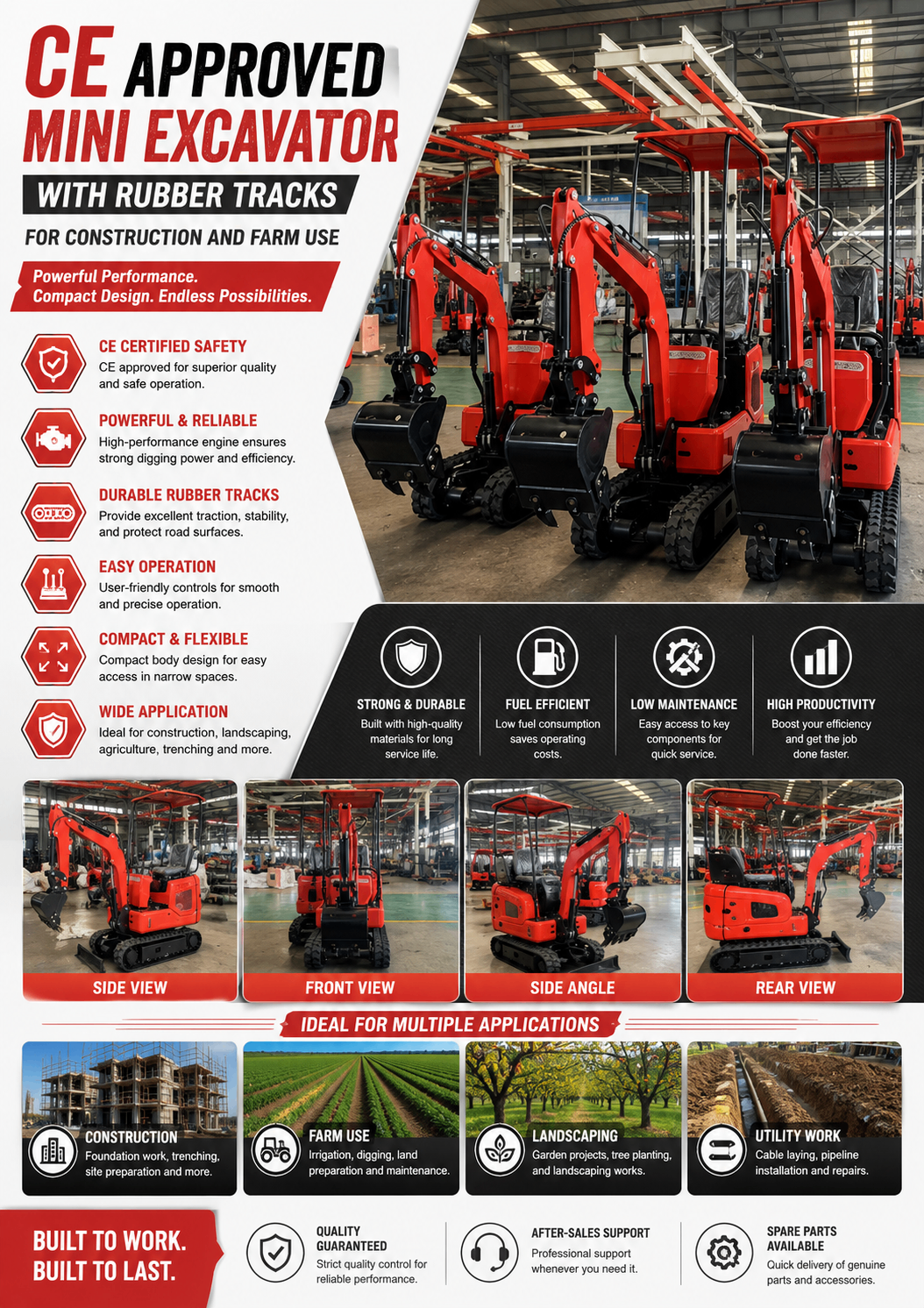
Ensuring your mini excavator meets EU accreditation requirements is essential for sales within European markets. These guide explains the necessary aspects of EU approval for compact excavators, covering regulations related to safety, construction equipment evaluation, and documentation. Knowing the requirements enables companies to safely operate their equipment and prevent potential fines.
Rubber Track Mini Machines: Superior Grip for Challenging Landscape
Mini machines equipped with rubber tracks are changing how contractors handle projects in rough situations. Unlike traditional tire-equipped models, these flexible machines deliver exceptional grip on slippery surfaces like gravel, snow, and steep grades. This improved balance allows operators to execute tasks safely and productively, lessening downtime and maximizing output. The yielding nature of composite tracks also diminishes ground compaction, preserving delicate surfaces and minimizing environmental impact.
Small Excavators: Big Performance in Limited Construction Locations
These robust miniature excavators deliver a considerable answer for tasks where large equipment cannot operate. Their smaller Mini hydraulic excavator profile permits access to restricted areas, like underground utilities or among existing facilities. Despite their size, they possess impressive excavating power and precision, allowing them perfect for a broad scope of building applications. Ultimately, small excavators symbolize a intelligent investment for contractors facing the problems of confined workspaces.
Compact Diggers for Properties: Flexibility and Effectiveness in Agricultural Jobs
Modern farming operations often require tools that can handle a variety of demanding jobs. Compact diggers are quickly becoming invaluable assets for producers, offering exceptional flexibility and productivity across a diverse array of farming duties. From digging for irrigation setups and water removal to relocating soil for constructing fences or platforms, these devices provide a powerful solution. They even excel at preparing land for cultivation, smoothing acreage , and processing materials with simplicity . Their reduced size allows them to function in limited spaces that larger vehicles simply cannot access .
- Excavating for Irrigation
- Shifting Soil
- Clearing Land for Planting
Determining the Ideal Mini Machine for Site vs. Rural Applications
When evaluating a mini excavator , it's vital to appreciate the key distinctions between site projects and agricultural operations . Building sites often necessitate increased strength , precision , and the capacity to operate in small locations. As a result, a powerful model with a broad selection of tools might be ideal . Conversely , farms frequently involve minimal digging amounts, frequent terrain leveling , and the need for small equipment to move through pastures . Ultimately , careful assessment of the intended workload is essential for making the suitable selection .
- Think about excavation distances .
- Evaluate the area limitations .
- Review the needed tools .
- Take into account moving issues.
{CE Certification & Mini Compact Equipment: What Users Must to Understand
Ensuring your {mini compact machine is meets the requirements of relevant European directives is crucial, and that's where {CE labeling comes with. This indicator demonstrates that the equipment has been assessed and meets health requirements, allowing free movement within the EEA . {For purchasers of these machines, understanding CE marking is essential . It isn't simply about having a sticker on the digger; it represents a process of construction and performance .
- Ensure the visibility of the CE identification.
- Consult the conformity document – this details the requirements the digger meets.
- Think about that CE marking is the supplier's responsibility – while operators must be informed of its significance.